|
|
|
Bulk carrier types: Ore carriers, OBO ships, Self unloader, Forest product carriers & more
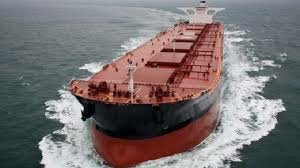
Ore Carriers
Ore carriers are specially designed and may only be
employed for a specific trade, eg carriage of iron ore in
bulk from major Australian or Brazilian ports to specific
ports in China or Japan.
Ships that are designated as ore carriers have to be
strengthened by class standards. In a seaway these ships
tend to be stiffer due to the high density of ore cargoes.
Typical dimensions of a large ore carrier are:
- LOA 340 m
- Breadth 60 m
- Draught 21 m
- Deadweight tonnage 323,000 metric tonnes.
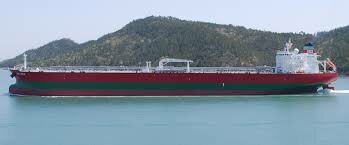
Oil/Bulk/Ore OBO Ships
These ships were designed to alternate between dry
bulk and oil cargoes, avoiding a non-earning ballast
passage by carrying both cargoes in the same cargo
spaces at different times.
They were designed with large hatches to facilitate
loading and discharging. However, the hatch covers
were designed to be `oiltight' so the same ship could
be loaded with oil cargoes with strengthened holds for
ore cargoes. For this dual purpose operation, OBOs
were fitted with pipelines, pumps and other oil tanker
equipment. Major problems on these ships included
gas freeing to load dry cargo after an oil cargo and the
high maintenance costs caused by heavy wear and
tear. Owing to the number of losses, notably the Berg
Istra (1976), Berg Vanga (1979) and the Derbyshire
(1980), combined with the high maintenance costs,
there has been a reduction in the number of these
ships, with few new OBOs built. Most remaining OBOs
are limited to one cargo type.
OBO construction is similar to that of a bulk carrier
except that they have larger wing tanks and their DB
tanks are deeper to improve stability when carrying ore
cargoes. Many OBOs have void spaces formed by fitting
transverse bulkheads between two cargo holds. Other
features of OBOs are:
- Oiltight hatch covers to allow the carriage of liquid
cargoes
- dedicated slop tanks
- pumproom for load/discharge of liquid cargoes
- inert gas system
- tank/hold cleaning system similar to the crude oil
washing system on oil tankers · ullaging equipment
- pipeline system (ballast, bilge and cargo) fitted
through the duct keel
- bilge lines (for use with dry cargoes).
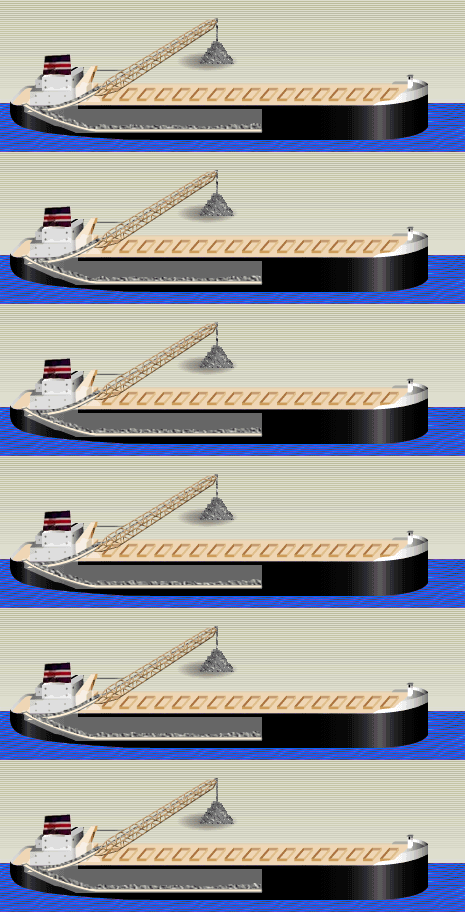
Self-Unloader Bulk Carriers
Similar in hull structure to other bulk carriers,
these vessels are fitted with one of two systems for
discharging cargo:
i) A gravity fed self-unloader: the cargo is dropped
onto a conveyor belt running in a duct keel under
the cargo holds that carries the cargo towards the
bow or stern of the vessel where another conveyor
lifts it for discharge ashore. The discharging arm
is connected to a boom that can be slewed into
position for discharge
ii) a hybrid self-unloader: commonly used, this
method does not require any special structural
design of the vessel. The cargo is discharged by
grabs into hoppers where it feeds onto a conveyor
belt. The hoppers can be permanently fitted on
the ship or may be placed on the deck of the
vessel when discharging.
These ships can discharge cargo in ports without any
unloading facilities. The discharging rates achieved
can be the same or higher than those of similar shore
based facilities. An added advantage is that a totally
enclosed conveyor system can discharge cargoes such
as cement, coal, grain, ores and fertilisers without
causing problems such as dust, cargo wastage, or
damage to the ship's structure by grabs or weather
effects.
While the initial cost may be high and the ship's
carrying capacity is reduced by fitting an unloader, this
is offset by the quick turn around and reduced port
stay.
Read more on self-unloaders various components and handling guide....
Open Hatch Bulk Carriers (OHBCs)
These vessels do not have upper and lower wing tanks
. Instead, they have straight sides to
carry square shaped bundles of forestry products such
as unitised wood pulp, rolled paper or packaged timber
cargoes. They can even carry twenty foot containers.
They may have fixed or travelling gantry cranes for
loading/unloading. Due to the nature of their cargoes,
these vessels may be fitted with:
i) Dehumidification systems
ii) vacuum equipment for loading/discharging
cargoes such as steel slabs/pipes, rolled paper,
unitised wood pulp, newsprint, kraft liner board,
kraft paper etc.
Forest Product Carriers
Open Hatch Bulk Carriers (OHBCs) can also be
regarded as a forest product carrier, this collective
term generally refers to the following ship types:
These vessels are designed to carry woodchips
(shredded wood) in bulk. Woodchip is described
as a `neobulk' cargo that requires methods and
precautions similar to those for bulk cargoes. They
are usually constructed with 6 watertight (in contrast
to weathertight) cargo holds to prevent water ingress.
This is particularly important as contact with water
causes woodchips to expand and could cause severe
damage to the structure of the ship. Additional security
measures to prevent water penetration through air
pipes and ventilation ducts to cargo compartments are
also incorporated to protect the cargo.
Carriage capacities are usually expressed in cubic feet
(or metres), eg for a Panamax size woodchip carrier of
length 205 m, breadth 37 m and draught of 10.5 m,
the capacity is 3.6 million cubic feet (CFT).
As the cargo holds fill, bulldozers are used to press
the cargo. Some ships are fitted with cargo loading/
unloading equipment including cranes, grab buckets
and wings with conveyor belts on deck (to pour the
chips into cargo holds).
When discharging, the ship's
cranes are used together with a grab bucket system
running at the bottom of the cargo compartments. The
cargo is carried to the forecastle by conveyor, where
it is discharged ashore through a single discharging
point. However, many ships use conventional grabs to
discharge the cargo.
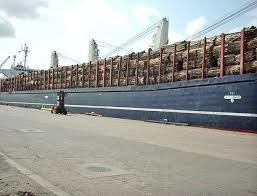
Timber Carriers
These vessels are used for carrying timber or logs
in the holds and on deck. The machinery space and
accommodation are located aft to provide clear
deck space for the cargo. Generally, they are fitted
with cranes that can handle logs that weight up to
25 tonnes. This means that the decks, tanktops,
hatch covers and other structures are additionally
strengthened to withstand these loads.
These ships
usually have fixed or portable uprights to support logs/
timbers lashed on deck. It must be ensured that there
is clear access to the mast houses, sounding pipes,
etc, during loaded voyages.
These vessels carry lashings that include turnbuckles,
wire ropes, chain, etc, fitted with a quick release
mechanism such as a senhouse slip to release the
deck cargo in case of emergency. On some ships, air
powered `speedlashings' automate the lashing and
tightening procedure.
The ship's lashing plan should be adhered to as
prescribed in the approved cargo loading manual.The Code of Safe Practice for Ships Carrying Timber
Deck Cargoes should be complied with for the
carriage of timber on these ships.
Wood Pulp Carriers
Wood pulp from soft trees such as pine, larch,
hemlock, fir and spruce is the most common material
used to make paper. The major hazard of wood pulp
cargo is that it swells if it comes into contact with
water, exerting enormous pressure on the structure
of the cargo hold and possibly causing a structural
failure. Additionally, this cargo depletes oxygen from
the environment and generates carbon dioxide, making
the atmosphere in the hold unsuitable for entry.
Considerable attention is required to avoid
contamination of the cargo by dirt or by residues of the
previous cargo.
Wood pulp is typically carried in bales that have a
protective covering to avoid any contamination to the
cargo. To assist in the protection of a wood pulp cargo,
holds are frequently repainted. Air bags are used to
prevent the movement of bales in the hold.
Hybrid Configuration (HyCon) Bulk Carriers
A recent advancement in bulk carrier design is the
`hybrid configuration' or `HyCon'. In this design, the
most forward and most aft holds have a double skin
but the other parts of the ship still have a single skin
. In this way, the areas that require
additional protection are strengthened without greatly
increasing the lightship weight.
A double skin enhances safety,
security, dependability, reliability,
and reduces the possibility of
damage from accidental flooding.
In addition, structures such as
frames and brackets located inside the double skin
structure provides a smooth surface for the cargo,
reducing problems with inspection or maintenance.
The potential for damage caused by cargo gear like
grabs or bulldozers is reduced, increasing the speed
of cargo discharging in port. The double hull makes
inspection much easier through the use of
passageways, ladders and manholes in the double
skin. Ballast capacity is also increased, which is an
added advantage in ballast voyages.
Bulk carrier size range
- Mini Bulk Carrier ,'Handysize','Handymax', 'Panamax",Capesize' ,Suezmax,Very Large Bulk Carrier ,Seawaymax ,Malaccamax ,Setouchmax ,Dunkirkmax ,Kamsarmax ,Newcastlemax etc.
Related Information
- Handling of bulk soda ash & safety preparations
- Hazards of handling copper concentrate
- Hazards of handling bulk sulphur
- Loading, carrying and discharging of bulk coal
- Special arrangements for carrying grain cargo
- Safety precautions for loading and carriage of iron ores
- Salt loading guideline - Precautions & hold preparation
- Petcoke loading in bulk & associated problems for bulk carriers
- Handling of bauxite - The environmental impact of Jamaica bauxite mining
- Carrying gypsum -Toxins, physical reactions & environmental degradation
- Bulk cement - Preparations, loading, carrying & handling precautions

Operation of sea going bulk carriers involved numerous hazards . Careful planning and exercising due caution for all critical shipboard matters are important . This site is a quick reference to international shipping community with guidance and information on the loading and discharging of modern bulk carriers so as to remain within the limitations as specified by the classification society. It is vital to reduce the likelihood of over-stressing the ship's structure and also complying with all essential safety measures for a safe passage at sea. Our detail pages contain various bulk carrier related topics that might be useful for people working on board and those who working ashore in the terminal. For any remarks please
Contact us
Copyright © 2010 www.bulkcarrierguide.com All rights reserved.
Although every effort have been taken to improve the accuracy of content provided the publisher of this website cannot take responsibility for errors. Disclaimer Privacy policy Home page

|
|
|
"A ship which is intended primarily to carry dry cargo
in bulk, including such types as ore carriers and
combination carriers"
Top articles
- Classification of various dry bulk commodities
|